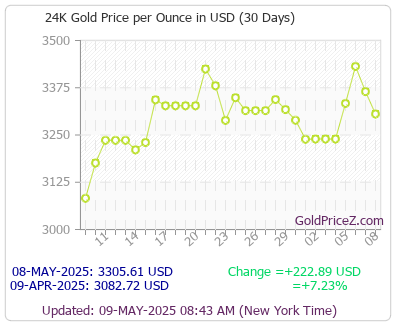
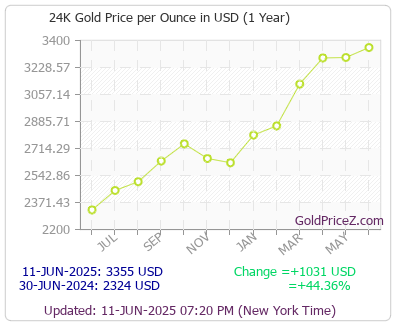
Welcome to the Gold Price in US Dollar (USD) per Ounce. The Current Gold Rate = $1953.55 USD per Oz, which is updated at 05:02:03 pm New York (USA) time (GMT-04:00).
What is Gold?
Gold is a precious metal, very uncommon and hard to discover and mine. It has been using as a source of preservation of wealth for more than 3000 years. It has very different chemical properties. For example, it is tough to dispose of, unaffected by many gasses, e.g., Hydrogen Sulfide and Oxygen, it is not rusting and nor it is stained. It cannot be dissolved below 1063 degrees centigrade. It is broken and dissolved only by Cyanide. South Africa was the gold largest gold producing country, and it was producing almost half of the gold originated in the whole world. However, recently, Australia became to largest Gold producing country. An ounce of 24k gold is 99.99% pure to buy or sell.
Why investors prefer to buy gold?
Investors see gold as opposing power against bad central-bank policies and inflations. Most of the investors observe gold as insurance against the financial instability, uncertain situations, high government expenditures, non-desirable policy of the central bank. The standard 24k gold becomes the ideal choice when real returns on bonds and cash are decreasing or falling, irrespective of a rise of the nominal interest rate.
What are the essential terms to understand the gold trade?
Bid Price: Current market spot price at which one can sell gold.
Ask Price: It is the current spot gold price of 24k gold at which investors can buy it.
Spot Price: it is calculated using the recent average of bid price and asks price.
Gold Price Fixing: It is carried out by the London Gold Market Fixing Ltd. It is also a benchmark for pricing the gold and its products.
What is the Gold Price Fixing?
It is a benchmark, which provides a standard rate for pricing the gold products in the world. It is because the gold price is changing at each instant of a business day due to various factors (i.e., demand and supply, inflation, speculation, war, etc.), so it is difficult for an individual business maker to follow the spot price.
When is the gold price fixing?
Irrespective of Gazetted Holidays and Weekend (e.g., Saturday and Sunday), the gold price is being changed at each instance of time, e.g., each second of a business day. The gold price is fixed twice every business day, that is, at 10:30 am and 3 pm, by the “London Gold Market Fixing Ltd” at London time, in the US dollar (USD), the Pound sterling (GBP), and the Euro (EUR).
What are the factors that affect the Gold Price?
- 1. Demand and supply of Gold
- 2. Speculations
- 3. Hedge against financial pressure
- 4. Central Banks Strategies
- 5. The International Monetary Fund (IMF)
- 6. Industrial demands of gold
- 7. Buying more jewelry
- 8. War
- 9. National Emergency
What is the Gold Exchange Traded Funds (EFTs)?
It is a certificate that represents a part of gold present in vaults of a bank. If a person purchases a specific unit of gold (e.g., gold bar, etc.), then as the price in the international currency market changes, its value in the vault changes as well. It has some advantages and disadvantages, e.g., a person can buy and sell gold at spot price, instantly and virtually via one click. But it is considered an investment and taxes are imposed such as profit-taking and capital.
What are Gold Stocks and Shares?
Putting investment into the shares of a gold mining company can be productive, yet the value of the shares relies on numerous elements, not only the value of gold. A mining company is anticipating to deliver a specific measure of gold over the life of the mine, and this is the thing that gives it its worth. If the mining company misses the mark (or target), then the offer worth can miss the mark. Indeed, even an unfavorable development in the currency exchange rate of the country in which the mine is located can bring about a drop in the value of the gold produced by the mine. Here, you can find more information about top Gold Stocks and Shares.
What are Gold Futures?
It is a hazardous investment of standard 24k Gold per Ounce and another way to trade. Typically this is the area of the trader as opposed to the investor. The spot gold market is very volatile, and it changes gradually at each instant of time. Therefore, one can lose a considerable amount of money. This area is best suited to the specialists in the gold trade, requires a sound knowledge of Mathematics, Computer Science, statistics, Behavioral Science, Psychology, General Knowledge, and current affairs. In other words, understanding of current issues and technical analysis is required. It is normally traded in Ounce, which is a standard unit of trading gold.
What are Gold Coins?
The gold is a physical thing, easy to store, and simple to sell back in the market. It is a legitimate, delicate, and not taxed. The disadvantage is, plenty of coins will be difficult to store at home and fear of theft, but some banks can store them in vaults if one had an account in it. Gold bars likewise are simple to carry, store, and sell too. There might be tax contemplations with gold bars relying upon the reason pronounced for their buy. At the point when purchasing gold bullion, additionally consider that there is an increase in the price, over the spot gold price, as the investors or producers need to pay for their costs and so forth. However, with the increase in value, this may not be such an issue — gold coins available in different Karat, e.g., 24k, 22k, etc.
Coins were famous even in ancient times; they were using it for currency; still, gold coins are using in some countries as currency. Gold coins today are special coins, made of gold, available in a verity of sizes, different shapes mostly rounded, and a different type in different countries. For example, the officially recognized coins are the Canadian Maple Leaf, American Eagle, and the United States Mint, etc. These coins are also 99.5% pure.
What is a physical gold investment?
Physical gold is available in different types, shapes, and sizes in almost all countries of the world. For example, in a survey by GFMS, there were over 166,630 tonnes of physical gold by the year 2011 available in the financial market. They composed of the following type and mass:
- Jewelry: 52%
- Private Investment: 19%
- Official holdings: 16%
- Technology: 11%
- Unaccounted: 2%
They are available in markets. Bullion bars and coins are mostly used for investment of money, and jewelry is used to be worn, and it was used as an investment in the old-time, still, in some countries, it is used for investment.
What is the Gold Bullion bar?
It is a bar or ingot of gold of various sizes; bullion word originates from Louis XIII, Claude de Bullion, a French Minister of Finance. It’s worth relying on its purity /immaculateness and mass. Pure bullion gold (24k) is called parted bullion that is officially 99.5% pure, while impure, sullied gold is called unparted bullion (it involve different sort of metals), one example is 22k gold widely using in jewelry. Gold rocks are initially found, mined, and afterward, gold is extracted utilizing great warmth and distinctive chemicals, then changed over into billions.
What is Gold Jewelry?
Jewelry made of gold can be combined with other precious elements and gems to enhance its appearance and value. The value of jewelry depends on gold purity and mass, worth of gem used, and artistic work used to build it. Jewelry is used to be worn, and as an investment, e.g., 22k gold is the famous and 91% pure gold.
What are the largest gold producing countries in the world?
The following are four(4) largest gold producing countries, and they are producing more than 40% gold out of 2990 MT (i.e., produced by the whole world). Some decades before, they were not appearing in the map of the largest gold producers, but recently they became the leader of the gold market. These countries significantly affect the price of gold. They had the largest gold reserves and underground unmined gold. Though, there are some countries of the world, which claims of owning huge gold reserves. But there is no authentic proof of that.
1. China:
As per a survey conducted in 2014, China produced 450 Metric tons of gold, which is 15% of the world (that is 2,990 MT). Of course, China had a vast territory, and it has more mines than any other country of the world, still a considerable amount of gold underground that is around 1,900 tons, and had about 1762 ton gold reserves, and ranked on the sixth number. Therefore, China influence the International gold market, and can drive gold price up or down. The demand for Gold in China is also increasing day by day, and a significant percentage of gold is using in jewelry.
2. Australia:
The next largest gold producer in Australia as according to a survey of 2014, a whole continent that comprises of enormous size territory that producing around 274 metric tons of gold. Perth is very rich in gold, and Australia most of the gold is mined from this area. Having a reserve of around 90 tons and on the 38th number on the list. Australia is the country having the largest underground gold reserve is 7400 tons that are far greater than China, and the biggest exporter of gold that is around 14 billion dollars.
3. Russia:
It produced 247 metric tons of gold that are closer to Australia, and 3rd number in the list of largest gold producing countries. In January 2016, Russian gold reserves exceeded the 1414 tons limit and currently in the list of owning most gold reserves. Russia does not export a considerable amount of gold but imports to increase the reserves. Around 5,000 tons are underground and unmined.
4. United States:
The gold production of the US has increased recently, and in 2014 the US produced around 211 Metric tons of gold. Its largest gold producing area in Nevada. The US has the largest gold reserves of 8,133 tons that are the largest in the world. The USA also has the credit of owning the largest gold vaults, located in New York, having gold of other countries of the world that is 25% of the gold vaults of the whole world, most of them are gold of reserve banks of around 49 countries, its mass is more than 6000 tons, these vaults are underground and at safe place, most the gold came here after World War II. The US alone had around 9000 own gold reserves in vaults of the Federal Reserve and Treasury Department.